


Kaeng Krachan National Park
The breathtaking mountain scenery of Kaeng Krachan
At 2,915 square kilometers, it is Thailand’s largest national park. Together with other protected areas, it forms the Western Forest Complex along the border with Myanmar. Established in 1981, it became a UNESCO World Heritage Site in June 2021. Unlike Khao Yai National Park (Thailand’s second UNESCO World Heritage Site), however, you’ll hardly encounter any tourists here. One reason is the lack of suitable accommodation in or near the park. It’s also somewhat harder to reach than Khao Yai, for example. But it’s definitely worth a visit!
Admission: 300 baht for adults, 200 baht for children. Thai citizens pay 100 baht for adults and 40 baht for children. There is an additional 30-baht fee for your own vehicle. The park is closed to visitors between August and October.
Important: The main entrance is open from 5 a.m. to 5 p.m.
Travel towards Phanoen Tung is permitted only between 5:00–8:00 and 13:00–15:00.
The park exit at Phanoen Tung is open only from 9 – 11:30 and 16 to 17!
Wildlife of Kaeng Krachan
Because of the park’s size and somewhat difficult access, spotting wildlife is a little more challenging than at Khao Yai. But it’s worth it! With fewer tourists around (such as noisy school groups), the wildlife is largely undisturbed. But as I said, the jungle isn’t a zoo. So bring a little patience!
Mammals
- Leopards
- Clouded leopard
- Bears
- Stump-tailed macaques
- Sambar deer
- barking deer
- Elephants
- Asian wild dog
- Golden jackals
- Gaur
- Serows
- Yellow-throated Marten
- civet cats
- crab-eating
Mongooses
- Gibbons and macaques
- Leopards

Reptiles
There are around 120 different reptiles in the park, including 70 species of snake. Don’t worry! Snakes are extremely shy!
- King cobra
- Reticulated python
- various types of vipers
- Clouded monitor lizard
- Siamese crocodile
- Asian forest tortoise
-

Birds
The park is especially famous among birdwatchers from all over the world for its rich variety of species. So far, 480 different bird species have been counted!
Among others
- 14 Hornbill Species
- 7 broad-headed species
- Racket-tailed Treepie
- Grey Peacock-Pheasant


Getting to Kaeng Krachan National Park

01
Car
Getting there from Bangkok: 230 km. Drive time approx. 3.5 hours. A taxi (or Grab) costs around 2,400–3,800 baht, or €70–€110.
02
Minivan
Minibus stop 57 at Mo Chit. Fare: approx. €4. Journey time: approx. 2 hours. You can also take a minivan from the city to the park HQ. From there, the only way to the campsite is by taxi, for about 1,200 baht (approx. €35).
Accommodation
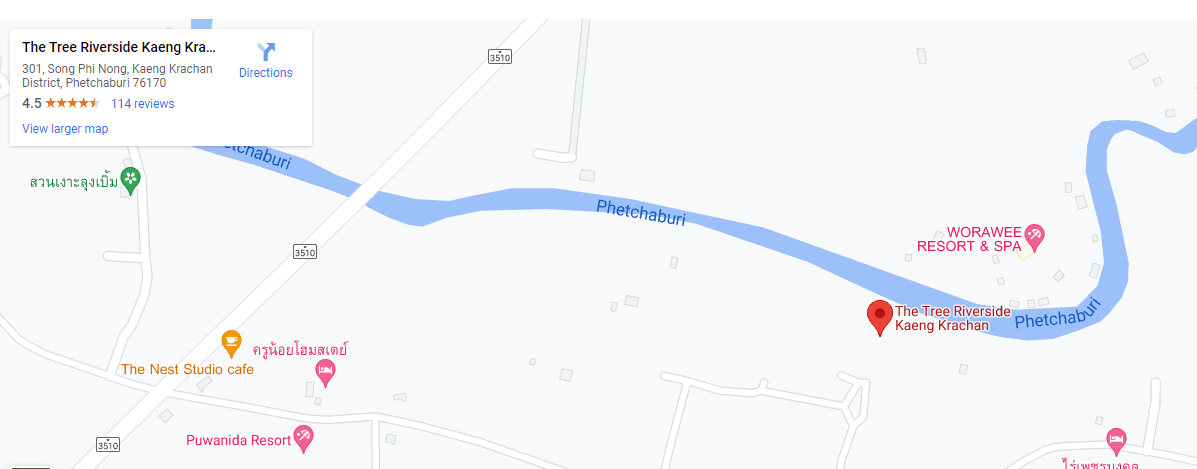
The Tree Riverside Kaeng Krachan
A room at this popular hotel costs around €53.
A special feature is the so-called Tent Zone, where you can stay in luxurious tents.
Address: 301 Moo1 Song Phi Nong Kaeng Krachan District Petchaburi 76170
Contact:
Email:
reservation@thetreeriverside.com
Website:
www.thetreeriverside.com

Nana Resort Kaengkrachan
Rooms at this particularly family-friendly resort start at €52.
Address: 139 moo13, baan-tongeth, Kaeng krachan, Kaeng Krachan, Phetchaburi, Thailand, 76170
Contact:
Phone: +66 32 706 139


Baan Maka Nature Lodge
At this traditional Nature Lodge, you can book rooms for €23. The appeal of the property lies in its setting amid the landscape, which gives you a taste of what to expect at Kaeng Krachan.
Address:
Baan Maka Nature Lodge84 Moo 8Ban Song Pe NongKaeng KrachanPhetchaburi 76170
Contact:
Email: baanmaka@yahoo.com Phone: +66 (0) 655630672


Camping in the national park
Spending the night at a campsite in the national park is a special experience. I’ve had some amazing wildlife encounters here at night! The Phanoen Thung Camping Platz, about 28 km inside the park, is especially recommended. In the evening, you can see hornbills, porcupines and yellow-throated martens, among other animals.


Jungle tours with Tontan Travel - Toni and Tan
For many years, I’ve been taking jungle tours with the two people at
Tontan Travel
I trust them completely in the jungle, and exploring the wildlife and plant life with them is a special experience. Toni is also one of Southeast Asia’s best wildlife photographers and one of the country’s top snake experts!
Leopard cat
There are 12 different species of these beautiful wild cats, which were long hunted primarily for their fur (imports were not banned in Germany until 1988). They’re about the size of domestic cats, but have longer legs.
Asiatic Black Bear
It can grow up to 2 m long and weigh 200 kg. They often have a white marking on their chest. They can be found in many national parks in Thailand. However, their numbers are said to have halved over the past 20 years.
Asian wild dogs
Only about 2,500 are thought to remain in the wild. The population is critically endangered! They live in larger packs, but split into smaller groups of two to four animals when hunting.
White-handed Gibbon
They leave their roosts early in the morning after sunrise and spend the next eight hours foraging. Their calls can be heard far into the rainforest.
COLLABORATIONS
Jungle tours in Kaeng Krachan with
Tontan Travel
01
2-day tour
A combination of game drives and jungle trekking, with an overnight stay at a campsite.

02
3-day tour
A combination of safari drives and various daytime and nighttime treks. Overnight stays at the campsite. There is plenty to discover around it at night!

03
Snake expedition
2-day tour. During the day, visit several observation points depending on the weather and conditions. After dark, join guided snake-spotting tours, where you may also discover numerous species of lizard.

04
The Great Bird Expedition
The usual birdwatching outing runs from 6 am to 7 pm. Where the tour goes depends on which birds you’d like to see. The best park in Thailand for birdwatchers!
